prior to their historic flight in 1903, the wright brothers owned a store that sold repaired what?
What If
Bicycles Held the Secret to Human being Flying?

Despite any formal training in physics or engineering, Wilbur and Orville Wright brought an utterly original and successful approach to the problem of human being flight. Isn't it amazing that all these secrets take been preserved for and so many years just and then we could discover them! Orville Wright, June 7, 1903
Brought to you by:

Delta's Innovation Story
On December 8, 1903, Samuel Langley, Secretary of the Smithsonian Institution, prepared to launch his plane over the Potomac River most Washington, D.C. Built with funding from the War Department and the Smithsonian, the aircraft – dubbed the "Airport" – benefitted from Langley's more than 15 years of flight enquiry. Only just seconds afterward launch, the Aerodrome plunged into the river.
9 days later, on December 17, two obscure brothers from Ohio quietly won the race for powered flight. Wilbur and Orville Wright successfully piloted their heavier-than-air, powered Flyer in the remote Impale Devil Hills dunes, near Kitty Hawk, N Carolina. The Wrights, working alone and without so much as a high school diploma betwixt them, solved a technical problem that had baffled the brightest minds for centuries.
Growing Up Wright
Milton and Susan Wright of Dayton, Ohio, encouraged intellectual curiosity, reading, experimentation, and tinkering in their home -- skills that shaped the methodical approach to problem solving used by their sons, Wilbur and Orville.


Milton, a Bishop of the Church of the United Brethren in Christ, traveled extensively and often brought back gifts for his children. I such nowadays was a rubber band-powered flight toy, Pénaud's Helicopter, which Milton brought home in 1878. The toy fascinated Wilbur and Orville and stimulated their first interest in flying machines.
From a young historic period, siblings Wilbur and Orville were inseparable. On one occasion Wilbur remarked,
"From the fourth dimension nosotros were little children, my brother Orville and myself lived together, played together, worked together, and, in fact, thought together. We usually owned all of our toys in common, talked over our thoughts and aspirations so that virtually everything that was washed in our lives has been the result of conversations, suggestions, and discussions between us."
They were besides exceptionally close to their sister, Katharine, who played a critical role in their eventual successes. Wilbur said of Katharine, "if ever the earth thinks of united states in connection with aviation, it must remember our sis." These three siblings remained in the family home most of their lives, with the brothers focusing on their many shared ventures in lieu of union. Wilbur and Orville established a printing store in 1889, when they were 22 and eighteen respectively. As the cycle craze swept the country, the brothers bought bikes, learned to repair them, and in 1893 opened their own wheel store. Somewhen, they even sold bikes under their own brand names, just the majority of the shop's income came from bicycle repairs.
By 1896, aeronautic enthusiasts were already cartoon connections between the skills needed to bicycle and those needed to wing. Residuum was essential to cycling, merely as information technology would be to flying. Coincidentally, bicycling, via the Wright Cycle Shop, supported the brothers' early aviation piece of work, both financially and through the wood- and metalworking skills they honed in that location.
The Challenge of Control
In 1896 Germany's Otto Lilienthal, the world leader in glider flying, died when his glider plunged to the ground. Lilienthal had completed more than than 2,000 successful glider flights, and his fatal accident jolted aviation enthusiasts worldwide. Lilienthal'southward sudden death reawakened the Wrights' interest in aviation. They scoured local libraries for anything related to aeronautics. When those sources were exhausted, Wilbur penned a alphabetic character to the Smithsonian Institution on May 30, 1899, requesting more information about "mechanical and human flight."
The brothers recognized that a successful flying auto required iii things: wings to provide lift, an engine to provide propulsion, and a means for the pilot to control the aircraft in flying. The brothers saw little trouble with the first ii points. Pioneers similar Lilienthal seemingly had mastered wings with their gliders, and the fledgling automobile industry presumably could provide a suitable engine. The third point was the true challenge.
Aerodynamic command had received lilliputian study. Near people attempting to build flying machines were but concerned with getting off the basis, and they attached petty importance to control. All the same, without the ability to control management and landing, manned flight would exist as well dangerous to be useful. To tackle the problem of control, the Wright brothers identified the three basic axes effectually which an aeroplane had to move: pitch (side-to-side or lateral axis), roll (front end-to-back or longitudinal axis), and yaw (rotation around the vertical or perpendicular axis). A airplane pilot must command the pitch, roll, and yaw of a flying machine in lodge to control it.
The Wright brothers studied birds and recognized that when turning or performing the ringlet motility, a bird simultaneously raised the tip of one wing while lowering the tip of the other. Yet, observing birds in flight never produced the "aha!" moment the brothers expected. Instead, the bicycle business clarified the trouble of controlling gyre, and ultimately, flight.
One evening in July 1899, lone in the cycle shop, Wilbur toyed with a rectangular bike inner-tube box, twisting it forward and backwards. The cardboard box performed the aforementioned movement as a bird in flight, and maintained stiffness, fifty-fifty when he twisted forcefully. Wilbur realized that by connecting the move of a flying machine'due south wings in relation to i another, twisting the axis of the wings in the same mode a box twists or a bird flies, a airplane pilot could control whorl. This breakthrough, nicknamed "wing warping," was the reply to controlled flight.
Testing Wing Elevator with a Bike
The Wrights were at present "fully afflicted with the conventionalities that flying is possible to man," as Wilbur wrote to Octave Chanute – a boyfriend aviation pioneer who would become a mentor. The brothers began testing with gliders. They asked the Weather Bureau where they might observe optimal winds and discovered Kill Devil Hills, on the Atlantic Ocean near Kitty Hawk, N Carolina. The remote location offered privacy, open space, and plenty of soft sand on which to land. The seasonal nature of the bike business allowed the brothers to remain at Kitty Hawk for several weeks each year.
The Wrights shaped their wings based on calculations made by Lilienthal. The glider pioneer had created elaborate tables indicating just how much lift should be generated by a wing of a certain contour. Their first glider tests at Kitty Hawk, in 1900, were encouraging, but the wings did not produce as much lift as Lilienthal's tables suggested. The Wrights returned in 1901 with larger wings, once more shaped according to Lilienthal, but the new glider performed fifty-fifty worse. Disheartened, Wilbur exclaimed on the railroad train ride dwelling house, "Non within a thousand years would man ever fly!"
The Wrights began to question Lilienthal's information, and sought to bank check it through a series of experiments in Dayton. They created a test apparatus past mounting a wheel horizontally across the handlebars of a bicycle.
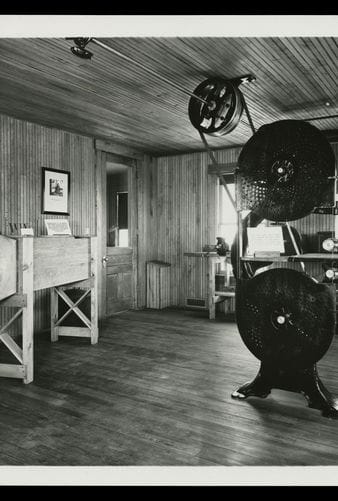
Reproduction of Wright Brothers' Current of air Tunnel inside Wright Cycle Shop, Greenfield Village, 1938
 Details
When the device did non deed in accordance with Lilienthal'southward information, the brothers knew they had institute their culprit. The Wrights and so built a air current tunnel consisting of a six-pes-long rectangular wooden box with a mechanized fan at i end, and a series of sensitive metal balances. Using model airfoils in the air current tunnel, Wilbur and Orville calculated their own lift tables. Their next glider, shaped by the new data, performed brilliantly at Kitty Hawk in 1902.
With control and elevator solved, the Wrights turned to ability. Though they had assumed that an adequate engine could be sourced "off the shelf" from an automaker, the Wrights could non detect a satisfactory unit. Instead they worked with mechanic Charlie Taylor, whom they had hired to tend the bike shop during their absences, to build a lightweight four-cylinder gasoline engine. With this final piece in place, the issues of lift, control, and propulsion were resolved.
Pioneering Aviation
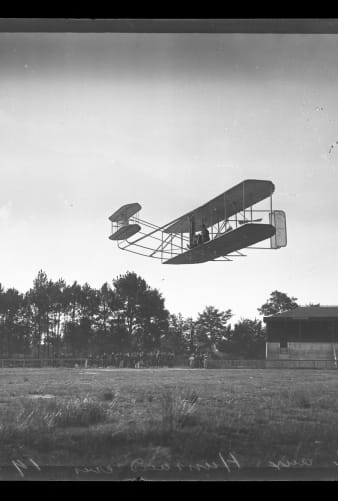
Wilbur Wright Flight at Hunaudieres Race Course, Le Mans, France, August 1908
Details
Near a quiet community on N Carolina's outer banks, on December 17, 1903, Orville Wright became the first man to wing. That start flight lasted only 12 seconds and covered 120 feet, but afterwards that solar day, Wilbur flew for 59 seconds over a altitude of 852 feet.
The Wright brothers' success was built-in out of years of painstaking piece of work and attention to detail. Each problem they solved prepared them for the historic start flight. Like other innovators, the Wrights experienced their share of failures along the style, but they refused to let the setbacks cease them. With unfailing marvel, methodical problem-solving, and perseverance through complications, the Wright brothers accomplished what then many before them believed to be impossible.
Katherine White is Associate Curator, Digital Content at The Henry Ford.
Browse Collections
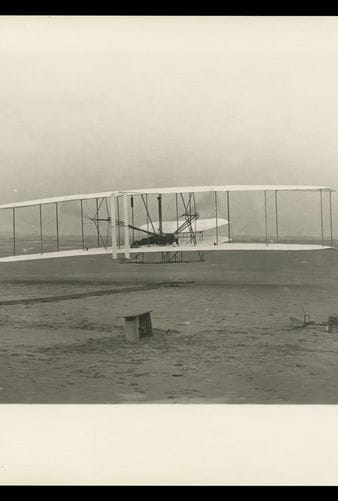

First Flying of Wright 1903 Flyer at Kill Devil Hills, North Carolina, Dec 17, 1903
Details
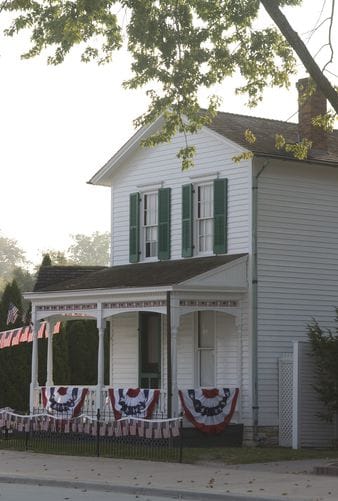
Wright Home
Photographed by Michelle Andonian
Details
Portrait of Wilbur Wright every bit a Boy, 1878
Details
Portrait of Orville Wright as a Male child, 1878
Details
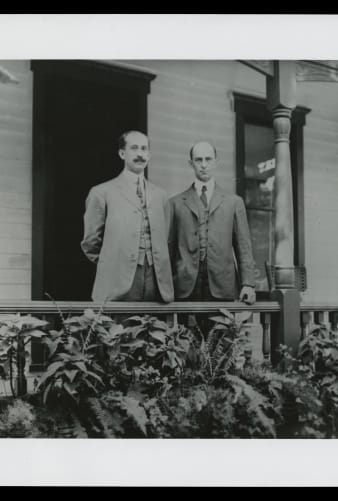
Orville and Wilbur Wright at Their Home in Dayton, Ohio, circa 1910
Details
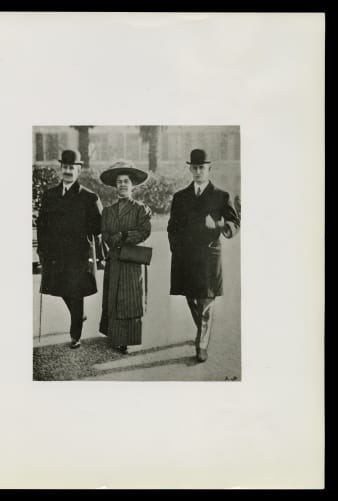
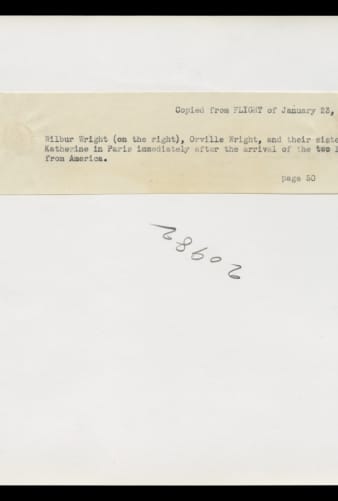
Orville Wright, Katharine Wright and Wilbur Wright in French republic, 1909
Details
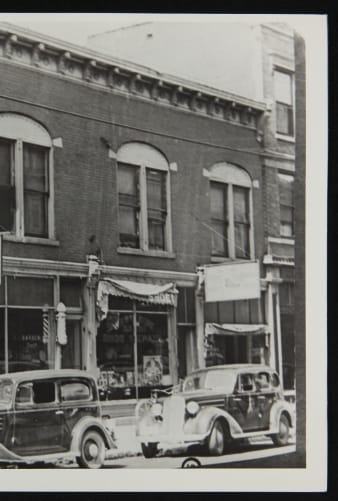

Wright Cycle Shop--Original Site--Exterior--Detail seven
Details

Word Questions
- What or who motivated the Wright brothers to introduce?
- What traits of an innovator did the Wright brothers illustrate?
- Which of these traits do you remember was most important to their success inventing the first flying motorcar?
- Practise you remember you could solve transportation problems of today with some of the same approaches fabricated famous by the Wright brothers? What transportation problem would yous desire to solve?
- Do you think y'all tin can be an innovator like the Wright brothers? Why or why not?
Fuel Your Enthusiasm
The Henry Ford aims to provide unique educational experiences based on authentic artifacts, stories and lives from America's tradition of ingenuity, resourcefulness, and innovation. Connect to more great educational resource:
Aspiring Innovators Resource Guide
burlingameshoebethe.blogspot.com
Source: https://www.thehenryford.org/explore/stories-of-innovation/what-if/wright-brothers/
0 Response to "prior to their historic flight in 1903, the wright brothers owned a store that sold repaired what?"
Post a Comment